Showing posts with label ASCD. Show all posts
Showing posts with label ASCD. Show all posts
Thursday, September 6, 2018


Monday, April 30, 2018
"Grading Smarter, Not Harder": Testing & Retesting
Testing & Retesting
How can you ensure that an assessment reflects student knowledge?
Let's begin with retesting and the problems with traditional classroom testing systems. According to Dueck, the following have been identified as problems with the testing system we are familiar with:
- flawed-tests cannot be revisited.
- little resemblance to reality
- test are a snapshot in time
- outcomes affected by unrelated variables
- low socioeconomic conditions are related more so with negative emotional factors
- negatively affect high-performing students as well.
- Traditional testing approaches discourage mastery
We should approach teaching more like coaching. Whether you are a dancer, an athlete, an artist, or musician, constant practice leads to mastery.
- embrace and celebrate mastery through repeated effort
- put systems in place to support and celebrate student mastery in the classroom.
Traditional approach ignores the learning that occurs during testing
- learning is active, not static.
- students should be given the chance to identify the mistakes made on tests, and re-test, and learn why they made the mistake
Potential Retesting Problems
- Students may need to complete a 2nd test in its entirety
- This can be discouraging to them
- a waste of time for student and teacher
- tiring amount of paper for the teacher
- Retests take up valuable Class Time
- completing the curriculum on time becomes an issue
- Retests can provide data of little value
- did learning really improve?
- Retests may not reflect authentic learning
Tuesday, April 24, 2018
"Grading Smarter, Not Harder": Unit Plan & Learning Targets (A module breakdown); Part 2
Part 2
Using learning targets efficiently requires us to form what Susan M. Brookhart and Connie M. Moss call a learning target parade.
Learning targets from a sequence of lessons will add up to a larger unit goal, or state standard. Daily learning targets include a description with words, pictures, demonstrations, or experiences.
All learning targets must adhere to the following criteria:
1. Describe for the students exactly what they are going to learn by the end of the day's lesson.
2. Written in a language the students can understand.
3. Written in the point of view of a student who has not mastered the knowledge or skill of the day's lesson.
4. Embodied in a performance of understanding--what the student will do, make, so, or write during the lesson -- that translates the description into action. Performance of understanding helps students get where they need to be in order to achieve the learning target, as well as giving them evidence of how well they are doing.
5. Include student criteria for success, or look fors, in a language that describes mastery of the learning target, not a score or grade.
Learning targets describe learning, not activities.
Monday, April 23, 2018
"Grading Smarter, Not Harder": Unit Plan & Learning Targets (A module breakdown); Part 1
Part 1
For my first weekly breakdown of Myron Dueck's "Grading Smarter, Not Harder" online workshop, we will be looking at learning targets. The role of learning targets in a unit plan is to offer a positive transfer, linking prior knowledge to the ultimate academic goal for the unit. An important key in ensuring students are learning and retaining the skills and concepts taught to them is letting them know what is coming up in their learning. Surprises put the students at a disadvantage. There are three strategies preparing students for the road ahead.
First, offering student-friendly unit plans. An effective unit plan identifies which type of targets students will meet:
Monday, April 16, 2018
"Grading Smarter, Not Harder": A professional review and talking points
Over the next 5-6 weeks I will be sharing reviews and information from an online P.D. course based on the book, "Grading Smarter, Not Harder" by Myron Dueck. During my studies and projects for the N.J. E.X.C.E.L. my interest has been sparked by the current research and publications of assessments and grade reporting, and how it is changing. Thomas R. Guskey's "On Your Mark" is an interesting, and easy, read. He challenges the conventional ways we have been grading and report in school over the last 100 years.
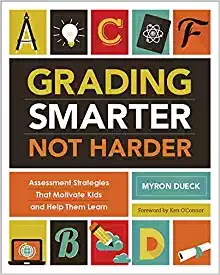 Below are topics I will be reviewing and sharing as discussion points from the course:
Week 1: Unit Plan and Learning Targets
Week 2: Issues with Traditional, one-shot unit test structure, development of reassessment structure
Week 3: Separating Behaviors and Academics when reporting
Week 4: Purpose of Homework (practice, reinforcement, and preparation)
Week 5: Creativity and Student Ownership
Monday, November 20, 2017
How to Introduce Group Work
Group work, when implemented correctly, can foster healthy communication skills and problem-solving strategies for all students. It takes less work for the teacher during a project and places more accountability on the students.
The article below, from ASCD Expres, discusses introducing group work to your students and setting them, as well as yourself, up for success.
"How to Introduce Group Work"
The article below, from ASCD Expres, discusses introducing group work to your students and setting them, as well as yourself, up for success.
"How to Introduce Group Work"
Tuesday, October 24, 2017
Habits of Mind (ASCD)

Watch A Webinar! Join Art Costa and Bena Kallick for a one hour webinar
in which they explore the 16 habits of mind and the use of animations as a
key tool for students to learn about the habits. Recorded October 5, 2017. Watch now
Free Infographic! Download this free infographic featuring the 16 habits of
Free Infographic! Download this free infographic featuring the 16 habits of
mind and use it to start implementing the habits in your classroom. Download infographic
ASCD resources

ASCD resources
Tuesday, September 26, 2017
Helping Ease Student Anxiety

One student passed out in the middle of a U.S. history presentation. "I watched her crumble and had to run and catch her," recalls Karen Grace, who teaches at Roosevelt High School in Seattle, Washington. Another student had a "full-on panic attack" during class.
The anxiety in the air these days is so palpable you can almost feel it, Grace says. "I walked more panicked students to the health center this year than in all my previous 15 years of teaching.
"Students are just coming unglued."
Subscribe to:
Posts (Atom)