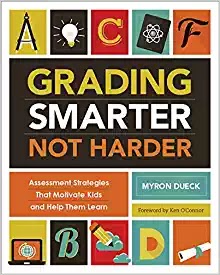
Over the next 5-6 weeks I will be sharing reviews and information from an online P.D. course based on the book, "Grading Smarter, Not Harder" by Myron Dueck. During my studies and projects for the N.J. E.X.C.E.L. my interest has been sparked by the current research and publications of assessments and grade reporting, and how it is changing. Thomas R. Guskey's "On Your Mark" is an interesting, and easy, read. He challenges the conventional ways we have been grading and report in school over the last 100 years.
Below are topics I will be reviewing and sharing as discussion points from the course:
Week 1: Unit Plan and Learning Targets
Week 2: Issues with Traditional, one-shot unit test structure, development of reassessment structure
Week 3: Separating Behaviors and Academics when reporting
Week 4: Purpose of Homework (practice, reinforcement, and preparation)
Week 5: Creativity and Student Ownership
Staff resource for instructional materials, student learning strategies, using technology in the classroom, Google Suite, and many other tools for the world of an educator.
Monday, April 16, 2018
Thursday, April 12, 2018
Article Review: Giving Students the Right Kind of Writing Practice
The authors of the following article (Gallagher and Kittle) discuss the importance of the right kind of writing practice. They firmly believe the only way to ensure a student improves their writing over time is through practice, and enough of it. The kind of practice is offered to students makes all the difference. All too often the practice we give kids in school to write actually may hinder their improvement, and turn them off to writing altogether. The rote standard practice of writing five paragraphs formula stunts their ability to develop their own voice and "denies them the crucial experience of organizing their thinking." (Gallagher and Kittle, 2018).
Their answer to what the proper kind of practice looks like in the classroom is creating a unit of writing for a particular genre in loops. Looping during units presents an opportunity of progress through skills necessary to become stronger writers. Student's volume of writing will increase, leads to deeper understanding, and increases a student's confidence as a writer. The article takes you through a sample narrative writing unit. The first lap focuses on short memories as the writer stays and focuses on one specific moment in time. Students read lots of mentor texts with the teacher, the teach models and writes with them. This only takes one week. During the second lap (one week) students still don't write an entire, but write only about a moment in a story (perhaps just a half a page long). Still studying numerous mentor texts. We study and write along side them. Lap three (three weeks) students are asked to create a series of scenes to tell a story. Students study the shape of stories and our focus is to look at the skills to build on what they learned during the first two laps. Focus on endings and look at how expert story tellers craft their stories. The fourth lap (three weeks) allows the teacher to differentiate instruction for those students who are still struggling with crafting several scenes. Others who are more advanced begin telling stories "through the lens of multiple narrators", a higher level of complexity.
I recommend this article to everybody, and perhaps this could help us to organize a scope and sequence, or curriculum map for our writing program. Let me know what you think. Could this work in you classroom?
(the article is also available on the Staff Resource Padlet, found here >>> )
Their answer to what the proper kind of practice looks like in the classroom is creating a unit of writing for a particular genre in loops. Looping during units presents an opportunity of progress through skills necessary to become stronger writers. Student's volume of writing will increase, leads to deeper understanding, and increases a student's confidence as a writer. The article takes you through a sample narrative writing unit. The first lap focuses on short memories as the writer stays and focuses on one specific moment in time. Students read lots of mentor texts with the teacher, the teach models and writes with them. This only takes one week. During the second lap (one week) students still don't write an entire, but write only about a moment in a story (perhaps just a half a page long). Still studying numerous mentor texts. We study and write along side them. Lap three (three weeks) students are asked to create a series of scenes to tell a story. Students study the shape of stories and our focus is to look at the skills to build on what they learned during the first two laps. Focus on endings and look at how expert story tellers craft their stories. The fourth lap (three weeks) allows the teacher to differentiate instruction for those students who are still struggling with crafting several scenes. Others who are more advanced begin telling stories "through the lens of multiple narrators", a higher level of complexity.
I recommend this article to everybody, and perhaps this could help us to organize a scope and sequence, or curriculum map for our writing program. Let me know what you think. Could this work in you classroom?
(the article is also available on the Staff Resource Padlet, found here >>> )
Wednesday, April 11, 2018
Padlet: An Online Staff Resource
The following Padlet has been created as a resource for E.P.C.S. staff members. Available to all staff will be documents, information packets, research, articles, forms, and whatever else you think would be valuable to us. Please send me items you would like to share with the rest of us and I will update on a weekly basis. Some of the items on there already I have come across in my classes, researching, and looking for information for the classes I have been teaching.
Tuesday, April 10, 2018
Friday, March 9, 2018
Subscribe to:
Posts (Atom)

